Ladies and gentlemen, I'd like you to imagine with me a pattern of integers connecting the rhythm of a poem, a population of fictional rabbits, and the spirals on a sunflower. A sequence made from natural numbers in the simplest of ways, yet with so much depth that an entire mathematical journal has been dedicated to the infinitely many studies that come from it.
\(0,\ 1,\ 1,\ 2,\ 3,\ 5,\ 8,\ 13,\ 21,\ 34,\ 55,\ 89,\ 144,\)
it takes only a moment to see that the rule is simple, and in fact, every mother and father has done it: Add the previous two to get the next.
The numbers above form the well-known Fibonacci sequence, and here we will explore some myths and marvels that come from observations of its beautiful structure. Its beginning is modest and natural, but its story spans centuries and crosses cultures between mathematics and, well... Life.
Needless to say, the Fibonacci sequence has a deep and meaningful history. In mathematics, there are countless topics, like the Sierpiński triangle, a fractal that was formalized in 1915 by Wacław Sierpiński. This fractal structure is also very simple, elegant, and beautiful. But like the Fibonacci sequence, the Sierpiński triangle appeared on many church floors in Rome and in mosaics on the balustrades of ancient architecture, long before we attached Sierpiński's name to it. No, my friends... The history of our sequence began long before Fibonacci even took his first breath. In fact, unbeknownst to him, Fibonacci's rabbits were all thumping their feet to the rhythmic patterns of Sanskrit verse.
Let's travel to ancient India. Scholars here were studying such rhythms. A short syllable counted as 1 unit of time and a long syllable counted as 2 units of time. The scholars began studying the possible arrangements of short and long syllables within a given length of time. Let's look at this:
In one unit of time, the only possibility is:
Short.
In two units of time, we have 2 possibilities:
Short Short, Long.
For three units of time, we have the 3 possible arrangements:
Short Short Short, Short Long, Long Short,
and for four units of time, there are 5 where we have:
Short Short Short Short, Short Short Long, Short Long Short, Long Short Short, Long Long.
A mathematician would see this as a way to partition the natural numbers 1, 2, 3, 4,... into sums using only 1 and 2. For example,
\begin{aligned}
1 &= 1 \\
2 &= 1 + 1 = 2 \\
3 &= 1 + 1 + 1 = 1 + 2 = 2 + 1 \\
4 &= 1 + 1 + 1 + 1 = 1 + 1 + 2 = 1 + 2 + 1 = 2 + 1 + 1 = 2 + 2
\end{aligned}
and so on. The counts of syllabic arrangements (and partitions) each begin with 1, 2, 3, 5, 8, 13... Does this look familiar?
The scholars began to realize the additive rule "Add the previous two to get the next" as follows: Every rhythm ends with either a short or a long syllable. By removing a final Short syllable, we obtain a rhythm with one fewer unit of time, and by removing a final Long syllable, we obtain a rhythm with two fewer units of time. Adding the number of both types of rhythm gives you a count of every possibility. These foundations are the work of Pingala, who was the first ancient scholar to make these observations. Unfortunately, we don't have exact dates, but somewhere around 600 or maybe 800 AD, Virahanka explicitly mentioned the addition rule in his work on meter. Many Indian scholars knew the recursive rule before Fibonacci, so its history began not among populations of rabbits, but in the mathematics of language and rhythm.
Now we come to Leonardo of Pisa. The mathematician we all know as Fibonacci grew up with a connection to Mediterranean trade, which led him to Bejaia in Algeria, where he learned much of his mathematics using Indian numerals. He learned their methods of calculation, and in the introduction to his book, Liber Abaci, he described how excited he was. He was influenced by Indian arithmetic through the Arabic spoken word, the everyday needs of merchants, and by Euclid's geometry. Math reached him across many cultures, through teachers, books, travel, and the conversations that arose from those travels. Still, we don't really know whether he encountered earlier works on the poetic measures of Indian scholars. As happens so much in mathematics, it seems a bit like he made an independent rediscovery when, in 1202, he published his famous book "Liber Abaci" (The Book of Calculation). Here is where he presented to the world his hypothetical rabbit problem, which goes like this:
Assume that the population begins with a pair of adult rabbits, and that a young pair takes 1 month to mature. A mature pair breeds 1 young pair each month. Assume now that the rabbits are immortal. How many rabbit pairs are there after month 0, 1, 2, 3, ...?
Table 1: The immortal rabbit population.
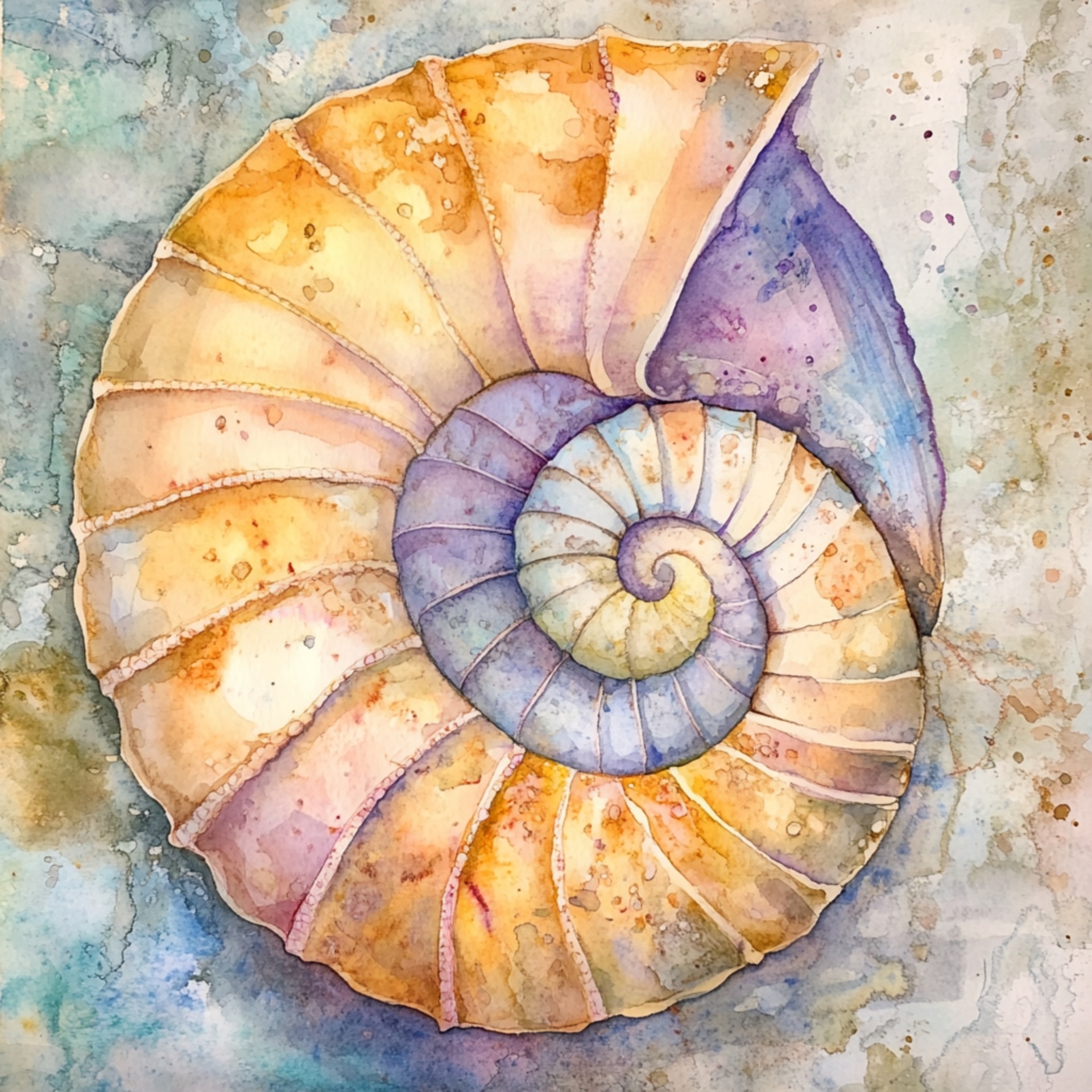
But rabbits, rhythm, and partitioning of integers aside, WHY does this sequence occur so frequently in nature? It's not like sunflowers can count, and, well... obviously pine cones cannot solve algebraic equations. Yet, their structures produce mathematical patterns that we identify with and even relate to abstract ideas from our own imaginations.
Many plants form new organs near a growing tip, and those positions depend on local biological processes. These include auxin transport, a plant hormone involved in growth. Existing growth sites influence where new sites can form, and under suitable conditions, these interactions generate spiral arrangements. By mathematically modeling auxin transport, important features of these patterns can be reproduced.
A particularly common angle between successive organs is approximately 137.5 degrees... $$\frac{720}{3 + \sqrt{5}}$$ (to be exact), also called the golden angle. As new organs appear and older ones move outwards with growth, the arrangements can display families of spirals running in opposite directions. Their counts are often consecutive Fibonacci numbers. This is why one might count 34 spirals in one direction and 55 in the other within a suitable flower head. Those spirals are patterns formed structurally, as opposed to tracks for which individual seeds travel. A good mental picture occurs when we try to imagine placing dots around a circle while gradually moving outwards. If each turn is a simple fraction of a full revolution, the dots will soon line up in repeating directions. A rotation using the golden angle will always avoid that kind of alignment.
Contrary to popular belief, it's not necessarily true that the golden angle allows plants to receive optimal sunlight. That is because research has shown that other angles perform equally well for light capture. The developmental patterns in plants usually reflect things like geometry and biological constraints.
So where does the golden ratio come into play?
Let's look at our immortal rabbits in Table 1 again. Observe that both the number of mature and young pairs form the Fibonacci sequence. The only difference between the two is that they are not equal, but consecutive Fibonacci numbers. If we denote the n-th Fibonacci number by Fₙ, then we have F₀=0, F₁=1, F₂=1, F₃=2, F₄=3, F₅=5, and so on. What we want is to examine the ratios of consecutive Fibonacci numbers (or the ratios of mature to young immortal rabbit pairs). We have:
\begin{aligned}
\frac{F_1}{F_0} &= \frac{1}{0} = \infty \\[4pt]
\frac{F_2}{F_1} &= \frac{1}{1} = 1 \\[4pt]
\frac{F_3}{F_2} &= \frac{2}{1} = 2 \\[4pt]
\frac{F_4}{F_3} &= \frac{3}{2} = 1.5 \\[4pt]
\frac{F_5}{F_4} &= \frac{5}{3} \approx 1.67 \\[4pt]
\frac{F_6}{F_5} &= \frac{8}{5} = 1.6 \\[4pt]
\frac{F_7}{F_6} &= \frac{13}{8} = 1.625 \\[4pt]
\frac{F_8}{F_7} &= \frac{21}{13} \approx 1.61538 \\[4pt]
\frac{F_9}{F_8} &= \frac{34}{21} \approx 1.61904 \\[4pt]
\frac{F_{10}}{F_9} &= \frac{55}{34} \approx 1.61765 \\[4pt]
\frac{F_{11}}{F_{10}} &= \frac{89}{55} \approx 1.61818
\end{aligned}
We can continue this forever, and the ratios will inch closer and closer to precisely agreeing with 1.6180339... or the exact number φ = (1 + √5) / 2, which we refer to as the "golden ratio". There is an elegant reason for this. Because each Fibonacci number is the sum of the preceding two, every new ratio is 1 plus the reciprocal of the previous ratio. This is easier to see by starting with the fact that Fₙ = Fₙ₋₁ + Fₙ₋₂ and dividing throughout by Fₙ₋₁. We have
$\frac{F_n}{F_{n-1}} = \frac{F_{n-1} + F_{n-2}}{F_{n-1}} = 1 + \frac{1}{F_{n-1} / F_{n-2}}$
As we consider larger values of n, the Fibonacci numbers grow larger and larger, and the ratios become closer and closer to their limit value. This limit is equal to 1 plus its reciprocal 1/φ. In other words, φ = 1 + 1/φ, which is precisely the property defining the golden ratio.
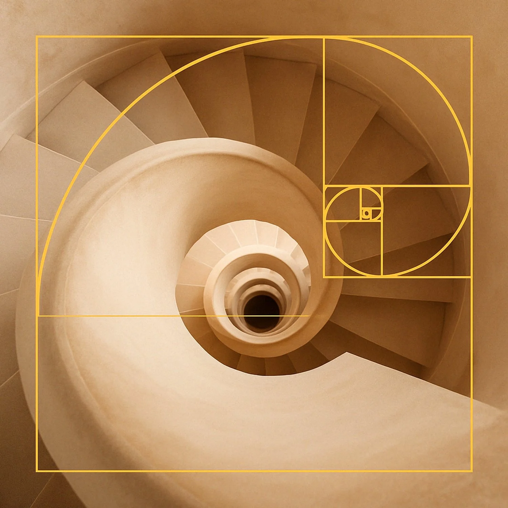
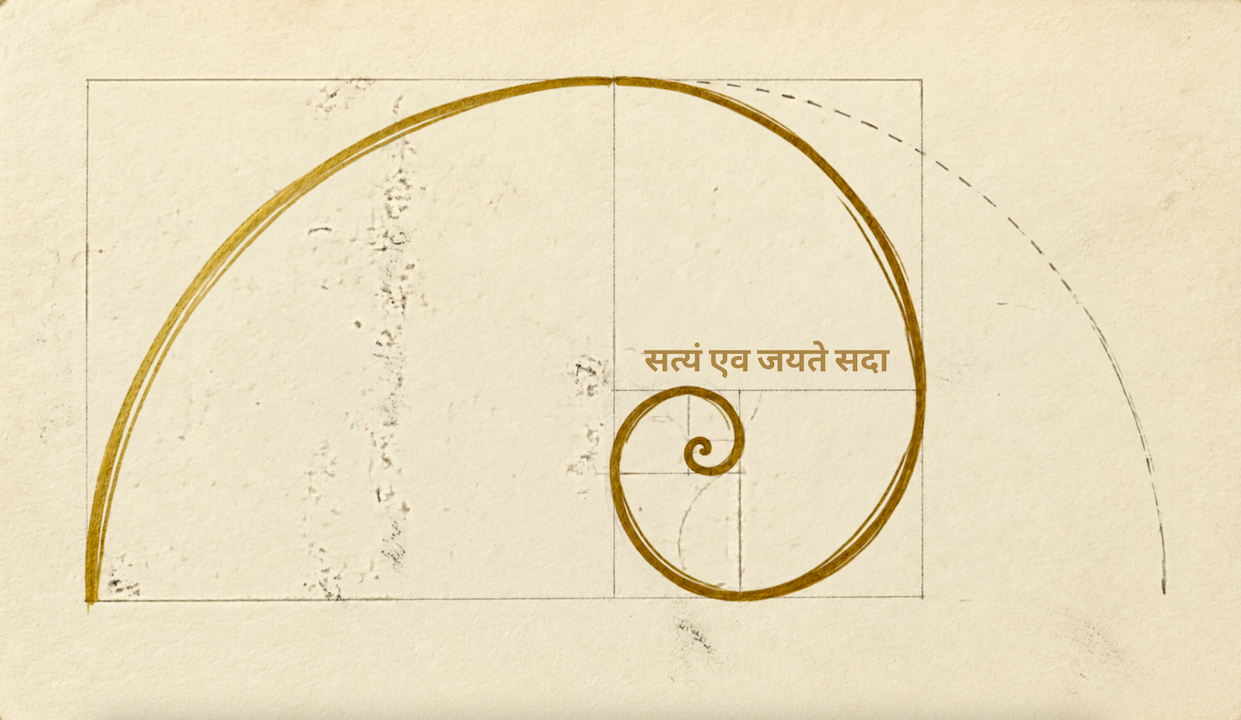
This brings us to an interesting question: Is every beautiful spiral a golden spiral? The fact of the matter is that beautiful spirals come in many forms. A golden spiral is only one particular logarithmic spiral, and of course, spirals are often beautiful even when they have nothing golden about them. But what I find especially interesting about this question is that our vast differences in how we perceive beauty can gravitate to a natural consensus. I can best illustrate this with an example.
On Halloween, I was celebrating my birthday, and I asked my friends and followers on Facebook to participate in an experiment. Well, I didn't get so many people to participate, but let's examine the results here today. I asked everyone to draw what they felt was the most aesthetically pleasing rectangle. After they did this, they sent me the measurements, giving the length and height. For anyone performing this experiment, it should be done so that no participant can see the previous person's rectangle. This can influence the participant's answers. The responses I received were:
- Heather: l=1.5 and h=1 giving the ratio 1.5,
- Sue: l=6 and h=4 giving the ratio 1.5,
- Christopher (Me): l=1.75 and h=1.25 giving the ratio 1.4,
- Dean: l=2 and h=1 giving the ratio 2,
- Kimberly: l=9 and h=4.75 giving the ratio 1.89, and
- Kyle: l=25/16 and h=17/16 with the ratio 1.4706.
If we add the ratios and take their average, we get about 1.6267. We need many, many more people to participate, but this is damned close to the golden ratio. So I CLAIM that if we were to ask every human on the planet to draw a rectangular enclosure for the immortal rabbits in a way that uses the most aesthetically pleasing rectangle, then the average of all ratios of long to short sides would have the golden ratio as its limit value.
Finally, we approach the point at infinity, where we might ask ourselves what it is about the golden ratio that leaves people contemplating the divine. Many people call it the divine ratio, and some place mystical importance on it. We use such words to describe feelings that are hard to put into words, like the awe of uncovering completely unexpected order, or the excitement and astonishment of seeing something simple unfold into magnificent complexity... complexity that somehow touches our sense of aesthetics.
A poet might arrange syllables, and while one mathematician might partition the integers, another might count immortal rabbits. The tradesman might work to build the perfect rectangular enclosure for the immortal rabbits, and while the plants to the side produce new growth, ALL of these different processes might lead to the same mathematical structures. Just because we can understand the mechanism beneath the marvel, this doesn't diminish the wonder of the intrinsic order in seemingly unrelated things. It definitely gives us the wherewithal to appreciate the petals of a simple flower and the measure of rhythm.
I am a mathematician and a prisoner... and even in this place of concrete and criminals, I am always in pursuit of beauty. One of the greatest forms of beauty within the Fibonacci sequence is that adding two numbers to get the next is a rule even a child can follow. Yet, it unfolds like origami into ideas that can fulfill a mathematician for an entire lifetime. Two numbers added together, and then two more... and suddenly there is a pattern worth pursuing.
$\varphi = 1 + \cfrac{1}{1 + \cfrac{1}{1 + \cfrac{1}{1 + \cdots}}} = \frac{1 + \sqrt{5}}{2}$